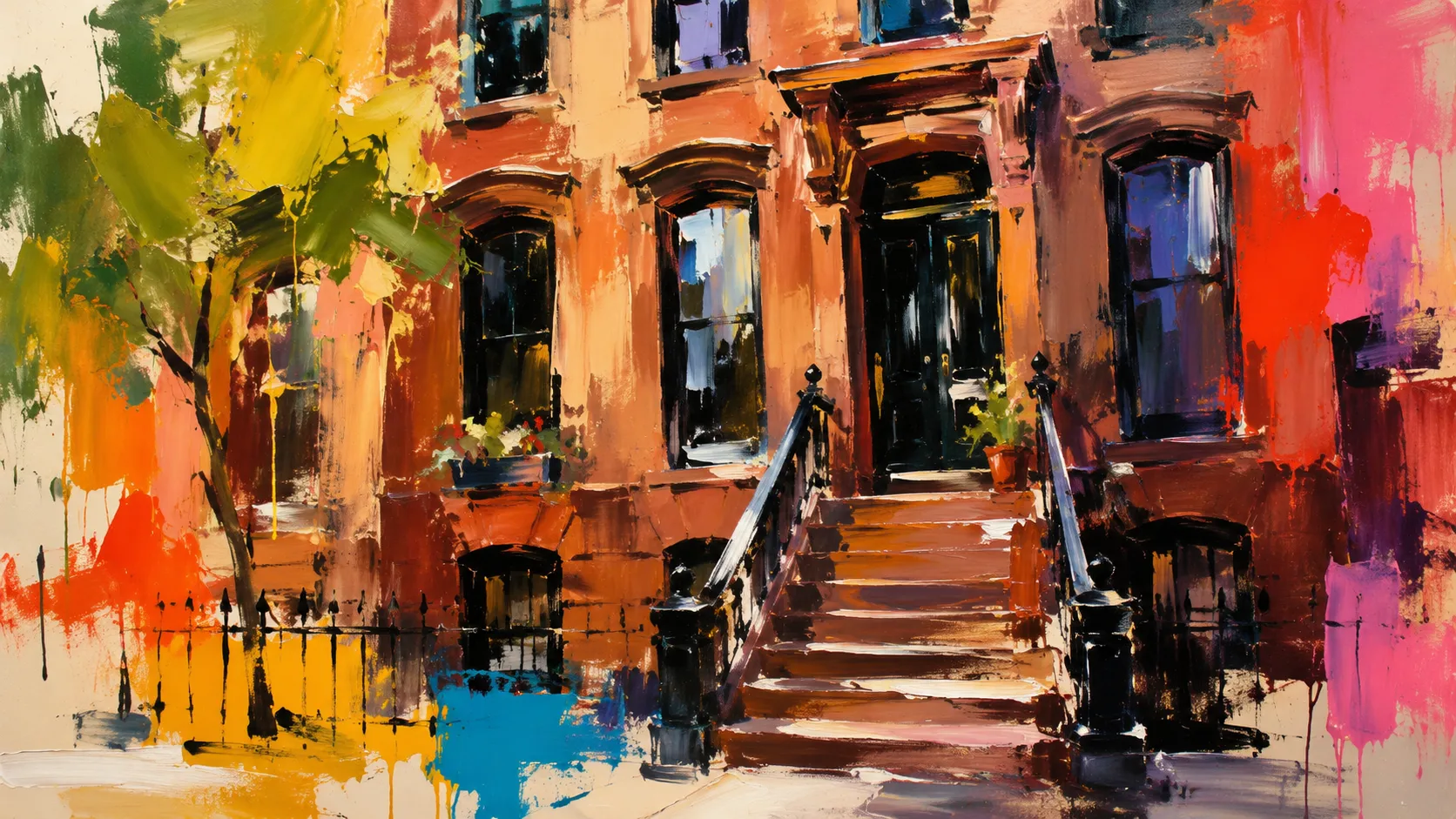
New York's brownstones have hosted just about everything, from one of the century's great abortion scandals to a Jazz Age salon packed with poets to a flower-covered stoop that goes viral every spring. Block after identical block of speculative housing, thrown up fast and sold to a rising middle class, became the stage for the city's private life. The fronts repeat from house to house, but the lives behind them never have.
The joy goddess of Harlem
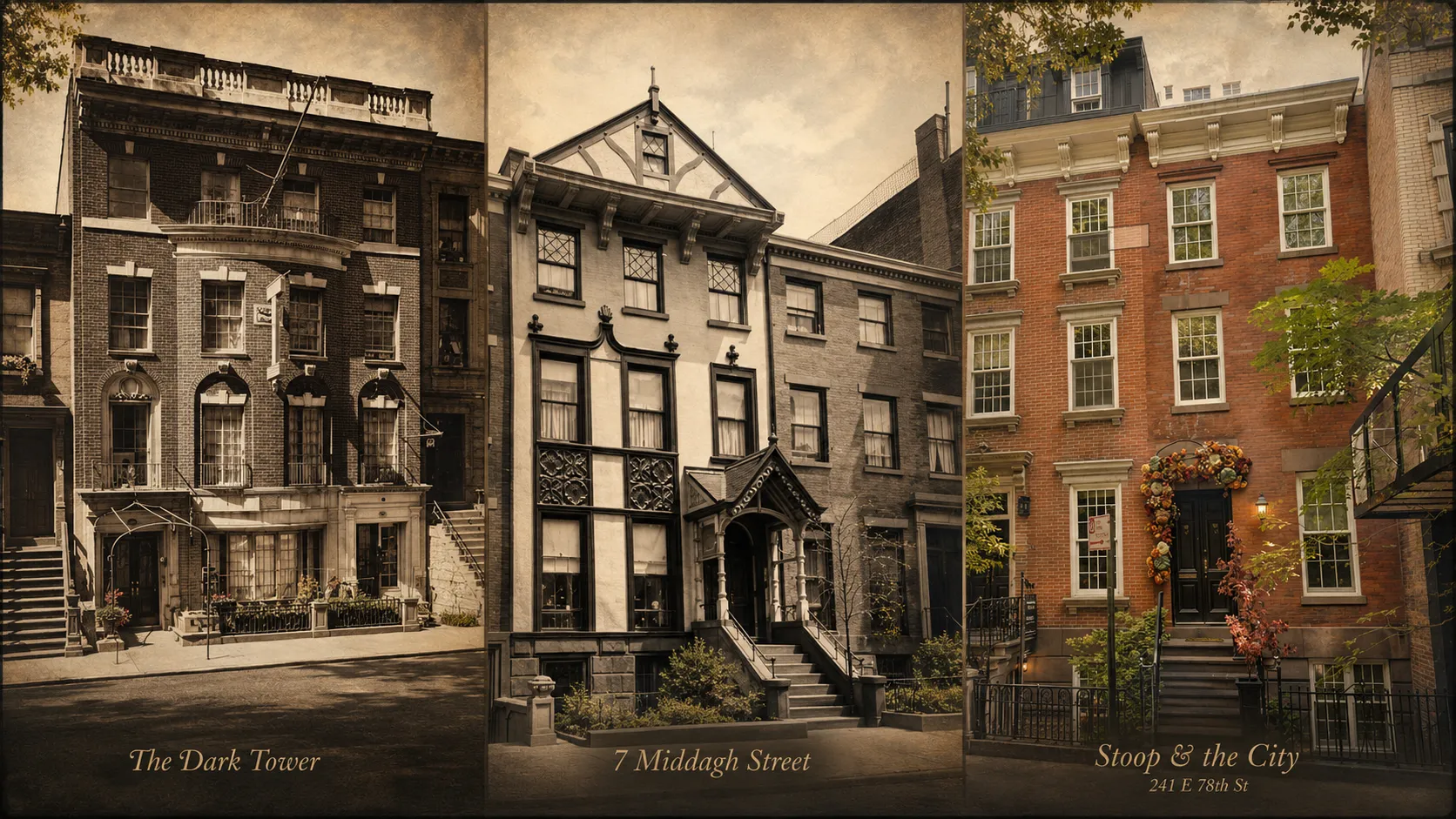
By the 1920s the most coveted invitation in the city was to a brownstone on West 136th Street, where the heiress A'Lelia Walker threw parties so crowded that Langston Hughes compared them to the subway at rush hour. Walker had inherited the fortune her mother, Madam C.J. Walker, built as America's first self-made female millionaire, and she spent it with flair. She fused two Harlem townhouses into one, hung the walls in gold, and filled the rooms with caviar, bootleg champagne, and a guest list that set W.E.B. Du Bois and Zora Neale Hurston beside white downtown swells and the gay artists and performers who found a rare welcome there. She named the salon the Dark Tower, after a Countee Cullen poem. Hughes called her the joy goddess of Harlem's 1920s. When she died in 1931, she went out on a midnight plate of lobster and chocolate cake washed down with champagne, which is about the most A'Lelia Walker way to go.
Brooklyn bohemia and a future gangster
For one year, starting in 1940, a brick-and-brownstone house at 7 Middagh Street in Brooklyn Heights held what might be the most gifted and least sensible household the city has produced. The poet W.H. Auden ran the place like a cross landlady, collecting rent from a roster that included the novelist Carson McCullers, the composer Benjamin Britten, and the country's most famous stripper, Gypsy Rose Lee, who wrote a murder mystery in her upstairs bedroom. A magazine editor named George Davis had signed the lease wanting a house full of artists. He got cocaine, whiskey, bedbugs, a tangle of love affairs that crossed every line the era drew, and a run of work that included two of McCullers's best books. The city later tore the house down for the expressway.
A few miles south, in Park Slope, a different kind of story was getting started. As a boy, Alphonse Capone lived with his family at 38 Garfield Place, on a brownstone block where the future Public Enemy Number One went to school, got expelled for hitting a teacher, and fell in with the local street gangs that gave him his start. Neighborhood rumor still says he stashed money in the walls of one of the family's houses on the block, which is the kind of thing neighborhood rumor always says.
The abortionist of Fifth Avenue
In 1864 the most notorious woman in New York moved into a four-story brownstone at Fifth Avenue and 52nd Street, paid for with money the city pretended not to understand. Ann Lohman, who worked under the name Madame Restell, had spent decades as the most famous abortion provider in America, advertising boldly in the papers and serving a clientele that reached well into respectable society. The mansion was a provocation, a grand house planted among the carriage trade by a self-made woman who refused to hide. The city tolerated her for years. That ended in 1878, when Anthony Comstock, the moral crusader who ran the New York Society for the Suppression of Vice, came to her door posing as a husband in need, bought what she sold him, and returned the next day with the police. Facing trial and ruin, Restell died by suicide before the case reached a verdict. The papers that had fed on her for thirty years ran it on the front page.
The houses that made the wrong headlines
Walk West 11th Street between Fifth and Sixth Avenues and one house breaks the row. The nineteenth-century fronts stand in a straight line until number 18, which juts forward at a sharp modern angle. The house that stood there came down on March 6, 1970, when members of the radical Weather Underground set off the bombs they were building in the basement by accident. The blast killed three of them. The actor Dustin Hoffman, who lived next door, was seen carrying valuables out through the smoke. The angled replacement that went up later is the rare New York row house that announces, to anyone who reads a streetscape, that something happened here.
A block away, 14 West 10th Street keeps its history better hidden. The brownstone is known in ghost-tour lore as the House of Death, supposedly home to a couple dozen spirits, the most famous of them Mark Twain, who lived there from 1900 to 1901. Twain, a committed skeptic, once shot at a piece of kindling that moved on its own near his fireplace, found a few drops of blood and no culprit, and never did get an explanation. The house carries a darker modern chapter as well, the 1987 killing of six-year-old Lisa Steinberg, a case that horrified the city.
Built by a woman the papers called Mister
Most brownstones never make the papers, and that anonymity is part of how they last. A good share of the ones Brooklyn fights hardest to save today were built by a woman the newspapers of her own day kept mistaking for a man. Susanna Russell, an English immigrant settled in Brooklyn by 1870, became the first known female developer in the borough, and between 1871 and 1892 she and her husband put up nearly ninety row houses in what is now the Bedford Historic District. She was listed on her own projects as owner, architect, and builder, worked under her own name in the city directory, and turned up in the Brooklyn Eagle, more than once, as Mister S.E.C. Russell. Her houses are still standing, still lived in, and still being restored a century and a half later.
Keeping them standing has not been automatic. When a historic Bedford-Stuyvesant mansion was demolished in a single day in 2022, the loss galvanized neighbors who had watched the blocks erode around them. They researched their streets, gathered signatures, and in 2024 won landmark protection for two blocks of nineteenth-century brownstones, the kind of grassroots fight that decides whether a row like Susanna Russell's outlasts the next developer.
The stoop comes back to life
Saving the houses is one thing. Filling them with life is another, and lately that life has spilled back out onto the front steps. The stoop, those high front steps the Dutch first raised to get above a flooded street, has become a small public stage.
On the Upper East Side, a mother of four named Kristi Hemric started decorating her stoop in 2023 to make her neighbor's scaffolding less depressing, and it snowballed into a rotating public spectacle of flowers, fruit, holiday scenes, and a LEGO botanical garden built from more than a hundred thousand pieces. Strangers plan walks around it, school groups hold story time on the steps, and the family gets thank-you notes from as far as Argentina.
Across the river, Brooklyn has turned stoop gardening into a sport. The Brooklyn Botanic Garden's Greenest Block in Brooklyn contest has run for roughly thirty years, sending neighbors out to plant tree beds, window boxes, and front steps, and blocks like Lincoln Place in Crown Heights have taken the crown so often they now coach the rookies. The 2025 title went to a stretch of Eastern Parkway, the first block of apartment buildings ever to win.
A few neighborhoods over, in Bedford-Stuyvesant, an arts group called STooPS turns the front steps themselves into stages. Founded by the choreographer Kendra Ross, it runs a yearly festival where homeowners hand their stoops to dancers, musicians, and visual artists for an afternoon and the whole block becomes a gallery and a theater. The 2026 edition takes over Decatur Street under the banner joy as resistance, which is a fair description of the tradition as a whole.
What the brownstones have seen
The stone on these houses came cheap and wears badly, the floor plans repeat for blocks, and the whole type was cranked out as fast as the builders could lay brick. None of that explains why the brownstone has held the city's imagination for almost two centuries. What happened inside and on top of them does, from a Fifth Avenue scandal to a Harlem salon to a Brooklyn stoop buried in flowers. They were built to be ordinary, and they have spent a hundred and fifty years proving they are anything but.